Syntax Error
Food bridge - Hunger meets with needs.
"Code the Change, Sustain the Future"
Submitted
May 22, 2026, 6:35 AM
Last Updated
May 22, 2026, 6:35 AM
Project Links
Problem Statement
Food waste and hunger exist side by side in modern society. Every day, huge amounts of edible food are discarded from restaurants, weddings, festivals, hostels, hotels, and households, while many people, NGOs, shelters, and even stray animals struggle to access proper meals. The major challenge is the lack of a centralized, intelligent, and real-time system that can efficiently connect food donors with people or organizations in need. Existing food redistribution methods are often unorganized, slow, and dependent on manual communication through calls, messages, or social media groups. Due to delayed coordination, lack of location-based matching, poor logistics, and absence of food quality verification, a large amount of food becomes unusable before reaching receivers. Additionally, there is very little integration of modern technologies such as Artificial Intelligence, geolocation systems, or sustainability tracking in current food donation platforms.
Solution & AI Usage
Solution and AI Usage Foodbridge is an AI-powered food redistribution platform developed to reduce food wastage and help people, NGOs, and stray animals access surplus food in real time. The platform connects food donors, receivers, and volunteers through a centralized digital system. Donors can upload food details such as quantity, expiry time, image, and location, while receivers can view and claim nearby available food quickly. The project integrates multiple AI and intelligent systems to improve efficiency and sustainability. The first feature is CNN-based food freshness detection using TensorFlow.js and MobileNet. When a donor uploads a food image, the AI model analyzes the image and predicts food quality and freshness status. The second feature is the nearest donor recommendation system, where geolocation APIs and distance-based optimization help receivers identify nearby donors, reducing delivery time and food spoilage. The third feature is the Hunger Heatmap for map the area.
Full Description
FoodBridge: AI-Powered Smart Food Redistribution Platform
FoodBridge is an AI-powered smart food redistribution platform developed to reduce food wastage and improve food accessibility for NGOs, needy individuals, and stray animals. Every day, huge amounts of edible food are discarded from restaurants, households, bakeries, weddings, hostels, and festivals, while many people and animals continue to suffer from hunger. Existing food donation systems are often unorganized, slow, and dependent on manual communication methods such as calls, messages, or social media groups. Due to delayed coordination and lack of proper logistics, a large amount of food becomes spoiled before reaching receivers.
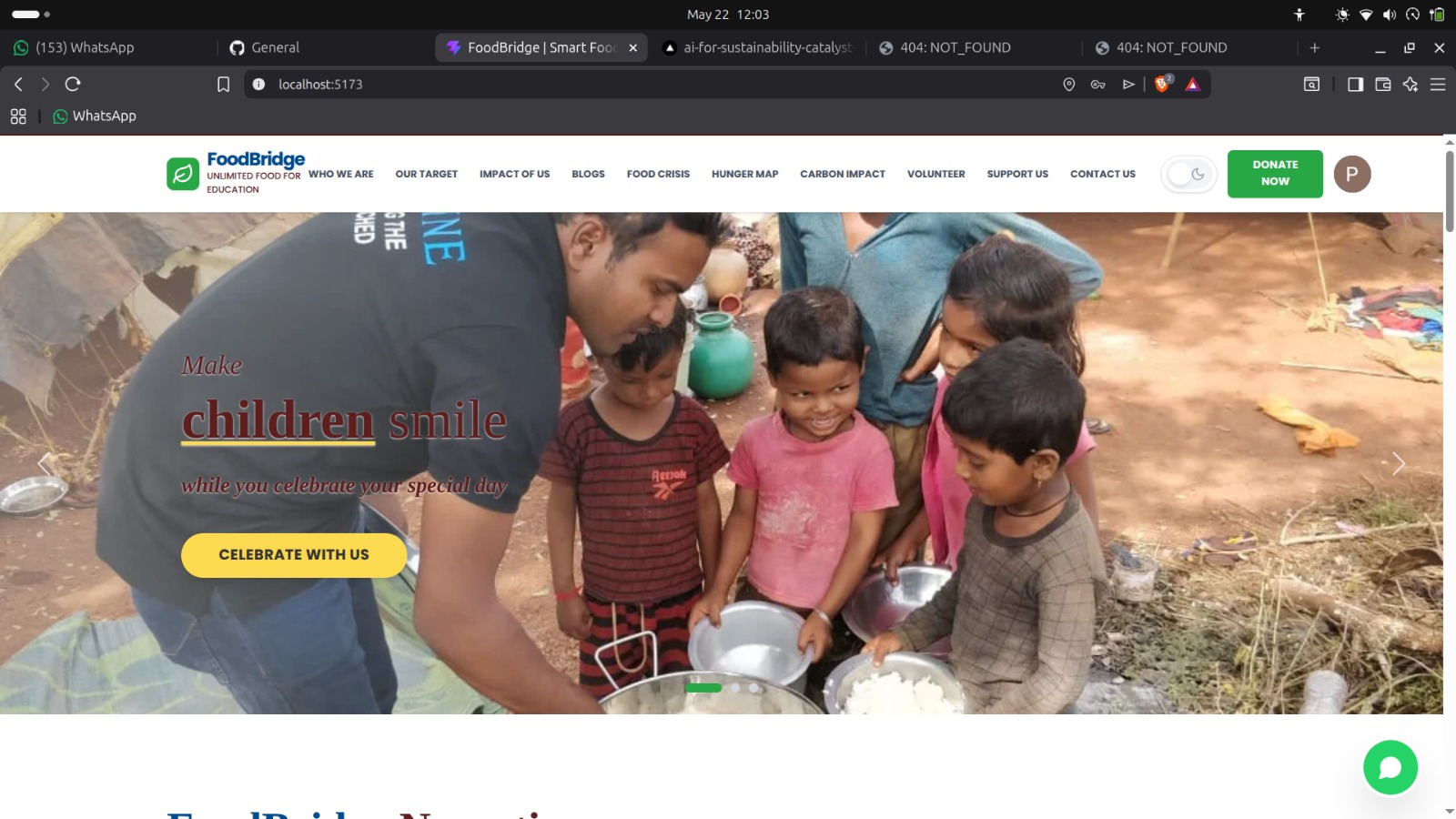
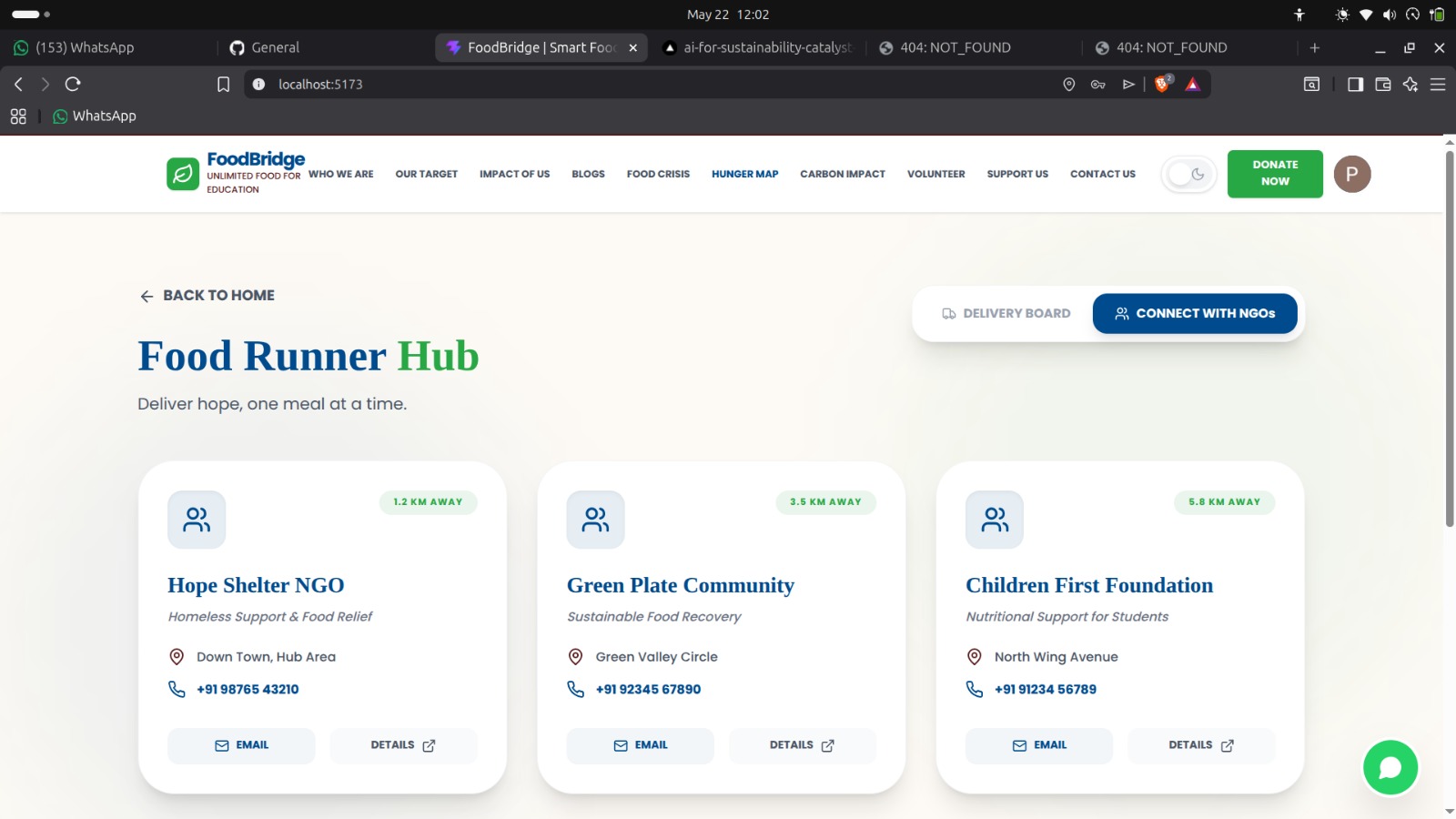
FoodBridge solves this problem by creating a centralized digital ecosystem that connects food donors, NGO receivers, personal receivers, and volunteers in real time. The platform allows donors to upload food details such as food name, quantity, expiry time, food image, and pickup location. Receivers can then view nearby available donations and request food quickly, while volunteers assist in transportation and delivery coordination to reduce delays and spoilage.
The project integrates multiple AI and intelligent systems to improve efficiency, reliability, and sustainability.
The first AI feature implemented in FoodBridge is CNN-based food freshness detection. We used TensorFlow.js with the MobileNet Convolutional Neural Network (CNN) architecture for food image analysis. When a donor uploads a food image, the AI model analyzes the image and predicts the food type, confidence level, and basic freshness status. The system categorizes food into levels such as Fresh, Moderate, or Possibly Unsafe. CNN models are ideal for image recognition tasks because they can detect textures, patterns, and visual features effectively. This feature helps increase trust in food donations and improves food safety awareness among receivers.
The second intelligent feature is the nearest donor recommendation system. One of the biggest challenges in food redistribution is reducing delivery time and preventing spoilage during transportation. The platform uses browser geolocation APIs and distance-based optimization to identify nearby food donors for receivers. Donor locations are captured using latitude and longitude coordinates and stored in the cloud database. When receivers log in, the system automatically prioritizes nearby donations. This improves redistribution speed, reduces transportation cost, lowers fuel usage, and minimizes food spoilage risk.
The third feature is the Hunger Heatmap System. This system visualizes food donation activity geographically using React Leaflet and OpenStreetMap technologies. Every donation uploaded to the platform contains geolocation data, which is displayed on an interactive map. Areas with higher donation activity appear as hotspot regions. The heatmap helps identify active redistribution zones, improves volunteer planning.
Tech Stack
Screenshots
3 attached