hashhitters
FlockChain AI
Submitted
May 21, 2026, 10:18 PM
Last Updated
May 22, 2026, 3:39 AM
Project Links
Problem Statement
India is the world's third-largest poultry producer, yet most small and mid-sized farms run blind — no continuous monitoring, no early warning systems, and no verifiable proof of biosecurity compliance. A single Newcastle Disease or avian influenza outbreak can silently wipe out an entire flock in 48–72 hours. By the time a farmer sees sick birds, the economic damage is done. And when they try to sell to processors, access bank credit, or claim insurance, they have no trusted data to show — just their word. The result: ₹thousands lost per outbreak, no accountability in the supply chain, and zero incentive to invest in better farm conditions. 85% of India's poultry farms lack any digital monitoring layer whatsoever.
Solution & AI Usage
FlockChain AI is a full-stack farm intelligence platform that gives Indian poultry farmers an early warning system, an operational co-pilot, and a tamper-proof compliance record — all in one. The AI layer does three things: First, it predicts disease risk 24–48 hours before visible symptoms appear. An XGBoost + LSTM pipeline continuously analyzes shed telemetry — temperature, humidity, ammonia, CO₂, water TDS — and flags anomalies against disease onset patterns. If the ML server is offline (a real constraint on Indian farms), a rule-based fallback engine built on ICAR-CARI and DADF standards keeps predictions running. No internet required to stay protected. Second, a PPO Reinforcement Learning model generates shed-specific operational recommendations — not generic advice, but actions calibrated to that farm's real conditions and history. Think of it as a precision agronomist available 24/7 at zero marginal cost. Third, the system calculates a Poultry Farm Sustainability Index (PFSI) —
Full Description
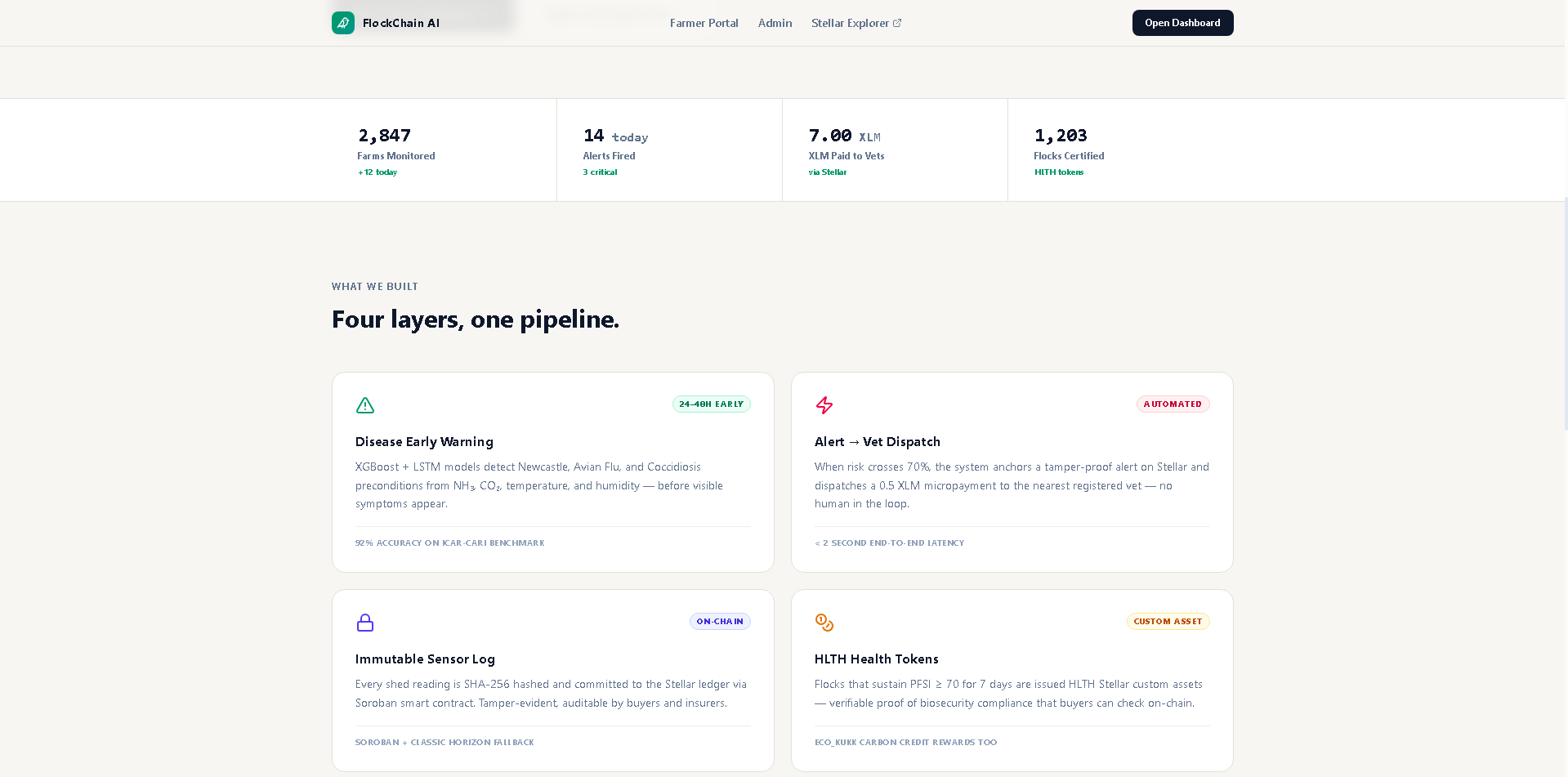
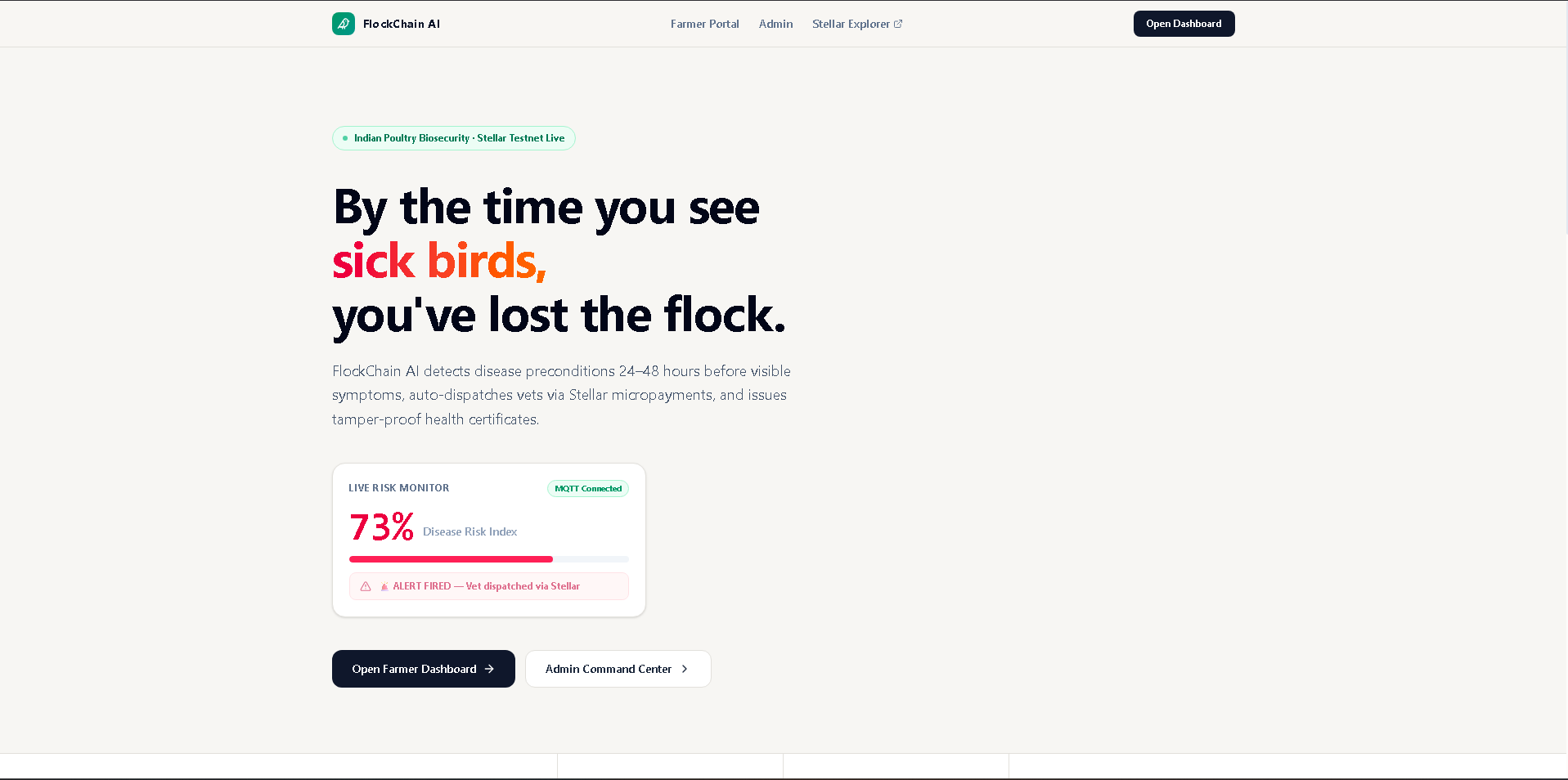
FlockChain AI is a full-stack farm intelligence platform built for India's small and mid-sized poultry farms — combining real-time IoT telemetry, multi-model AI prediction, reinforcement learning, and Stellar blockchain verification into a single, offline-resilient system.
— FEATURES —
Smart Telemetry: MQTT-over-WebSocket sensors stream temperature, humidity, ammonia (NH3), CO2, and water TDS continuously into an Upstash Redis cache, powering live dashboards for both farmers and administrators.
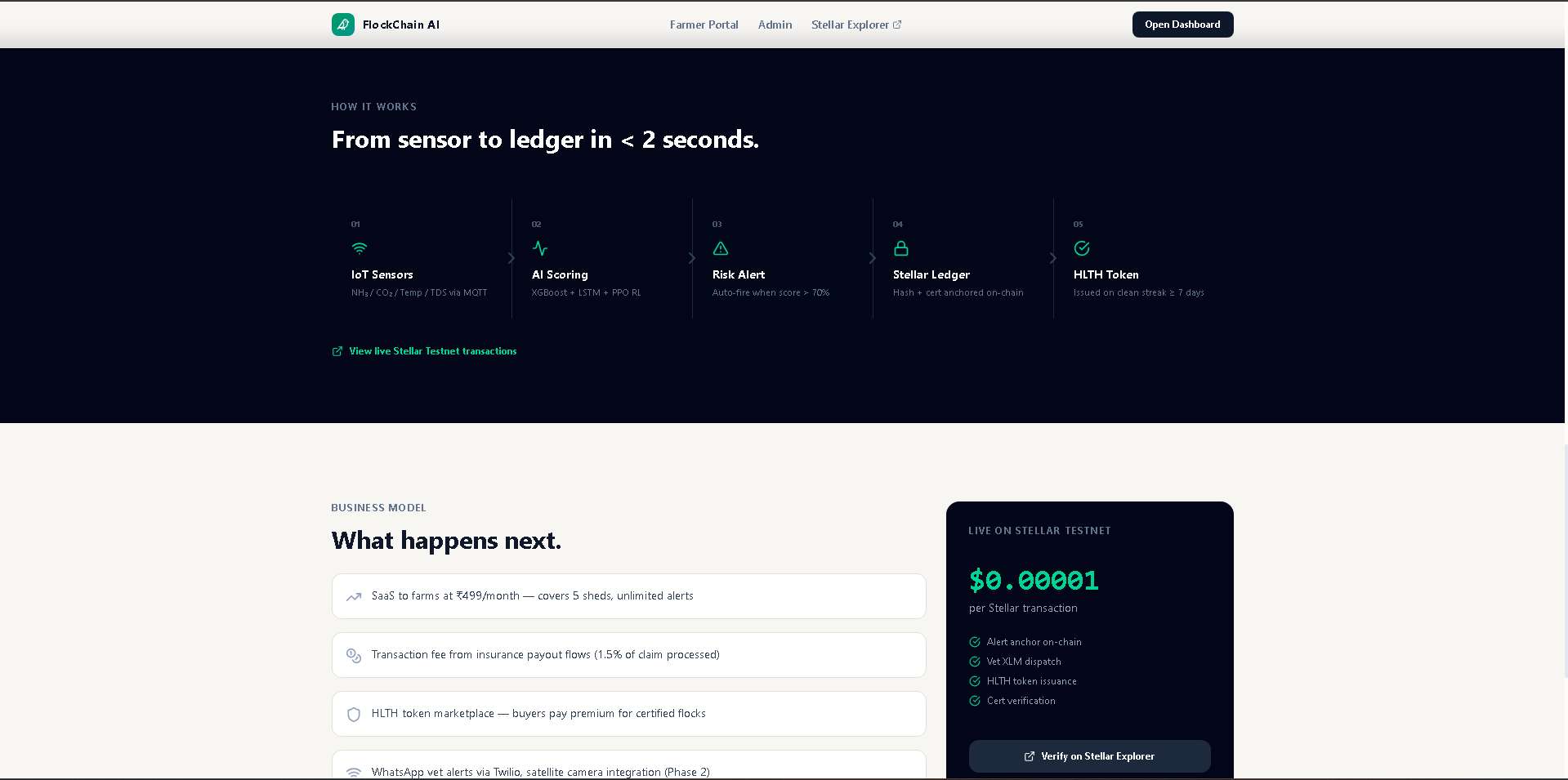
AI Disease Prediction: An XGBoost + LSTM pipeline detects anomaly patterns 24–48 hours before visible symptoms appear, covering Newcastle Disease, avian influenza, respiratory stress, and heat stress. When the ML server is unreachable — a real constraint on Indian farms — a rule-based fallback engine built on ICAR-CARI, DADF, and BIS 10500 standards activates automatically, ensuring zero downtime in disease risk coverage.
PPO Reinforcement Learning: A Proximal Policy Optimization RL model generates shed-specific operational recommendations calibrated to each farm's live conditions and historical patterns, replacing generic farming advice with precision guidance.
Poultry Farm Sustainability Index (PFSI): A weighted composite score across air quality (30%), water quality (20%), temperature (15%), humidity (15%), and weather adaptation (20%) converts invisible farm effort into a bankable credential. Farms scoring above 66 become eligible for on-chain rewards.
Blockchain Verification: Every sensor reading and compliance certificate is hashed and anchored on Stellar Testnet via Soroban smart contracts, with automatic fallback to Horizon Classic manageData operations. Certificates are verifiable by buyers, insurers, and inspectors via a public endpoint — no intermediaries. High-PFSI farms receive ECO_KUKK token rewards, creating India's first on-chain incentive layer for sustainable poultry farming.
Dual Dashboard System: A farmer-facing dashboard covers live telemetry, predictions, PFSI scores, weather integration via OpenWeatherMap, and Freighter wallet connectivity. An admin dashboard provides aggregate analytics, certificate management, and verification workflows.
— ARCHITECTURE —
IoT sensors or demo simulators push data over MQTT → Next.js App Router frontend → Upstash Redis cache → FastAPI Python ML service (XGBoost + LSTM + PPO RL) → fallback rule engine → PFSI calculation → Stellar Testnet (Soroban or Horizon). Deployed across Vercel (frontend), Render/Railway (ML service), and Upstash (cache). The ML server can also run via Google Colab + ngrok, enabling fully demo-safe operation without production infrastructure.
— CHALLENGES —
The hardest problem was graceful degradation. Indian farms face unreliable connectivity, so every critical layer needed a fallback: ML server down → rule engine activates; Soroban unavailable → Horizon Classic takes over; live sensors absent → demo simulation maintains full UI functionality. Building three independent
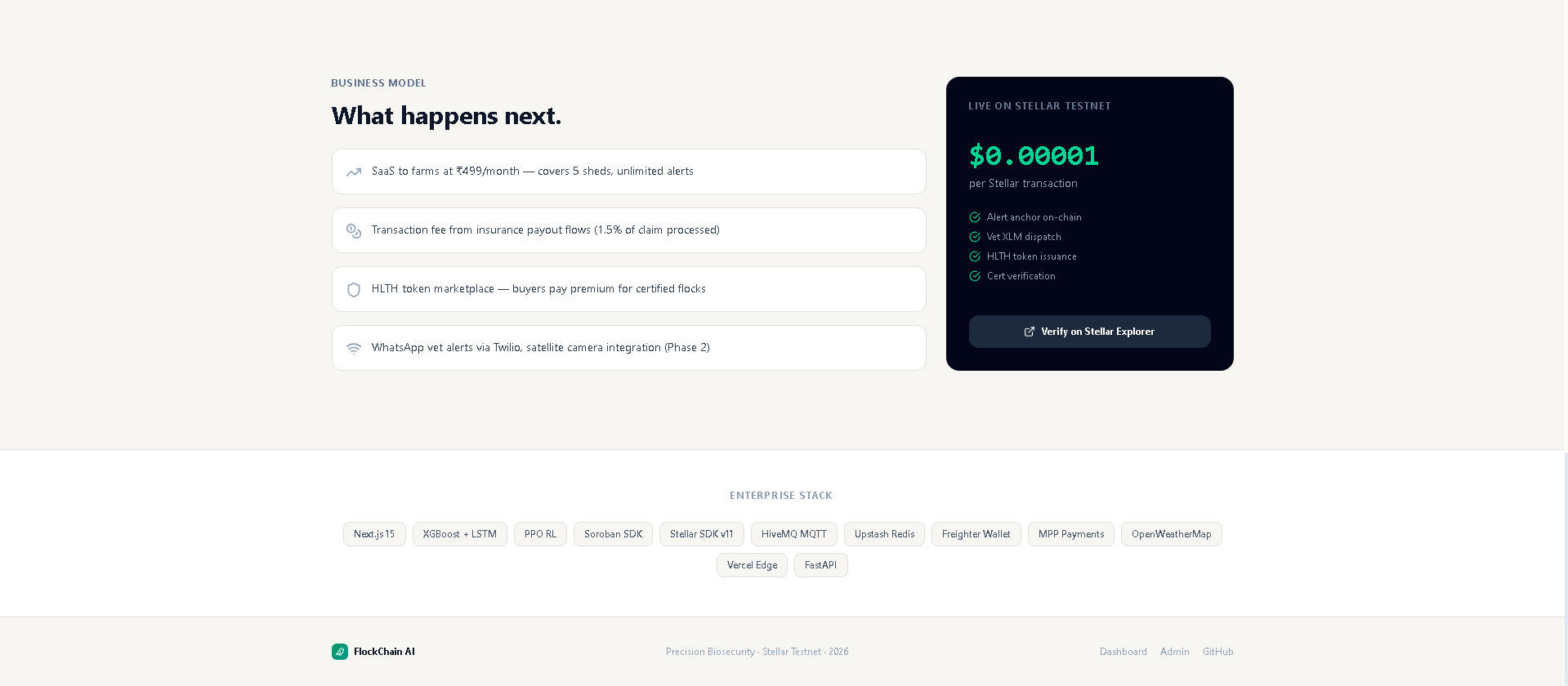
Tech Stack
Screenshots
4 attached