.jpeg)
B.I
VisionAid: AI-Powered Retinal Diagnostics with Immutable Blockchain Verification
"Built Different"
Submitted
May 22, 2026, 6:24 AM
Last Updated
May 22, 2026, 6:24 AM
Project Links
Official Winner
This project was recognized for outstanding achievement in the Healthcare category at Catalyst 2K26.
Problem Statement
Diabetic Retinopathy (DR) is a leading cause of preventable blindness worldwide. The tragedy of DR is that vision loss is highly preventable if caught early, yet the initial stages often present no noticeable symptoms. Currently, accurate diagnosis requires highly trained ophthalmologists to manually review retinal fundus scans—a slow, expensive process that creates massive bottlenecks in global healthcare systems. In rural and underserved communities, this specialized care is practically inaccessible, leading to delayed treatments and irreversible blindness. Furthermore, as telemedicine grows, ensuring the clinical integrity and tamper-proof security of digital medical reports has become a critical challenge. There is a desperate need for an accessible, rapid, and cryptographically secure diagnostic tool that empowers general practitioners to screen for DR instantly while guaranteeing patient trust.
Solution & AI Usage
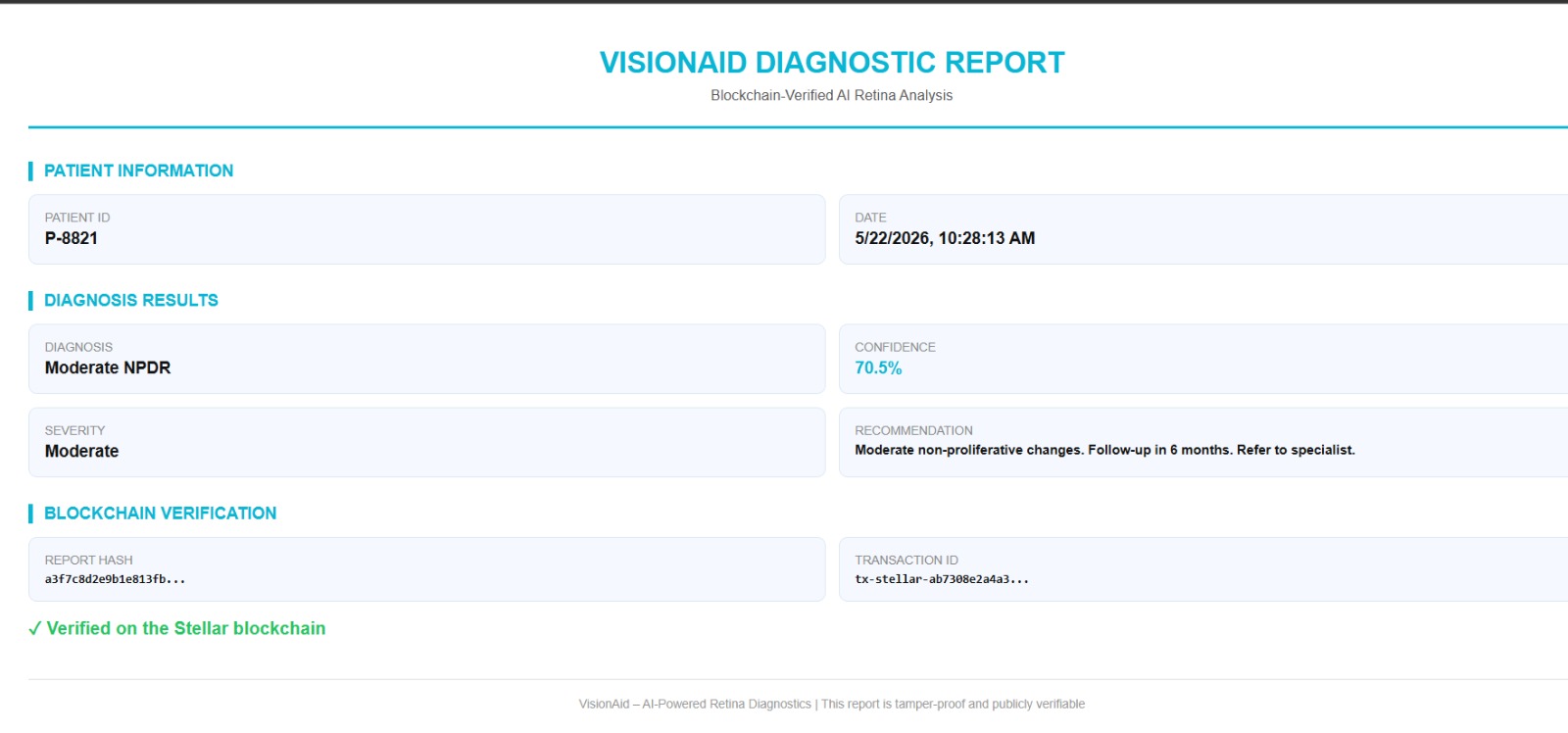
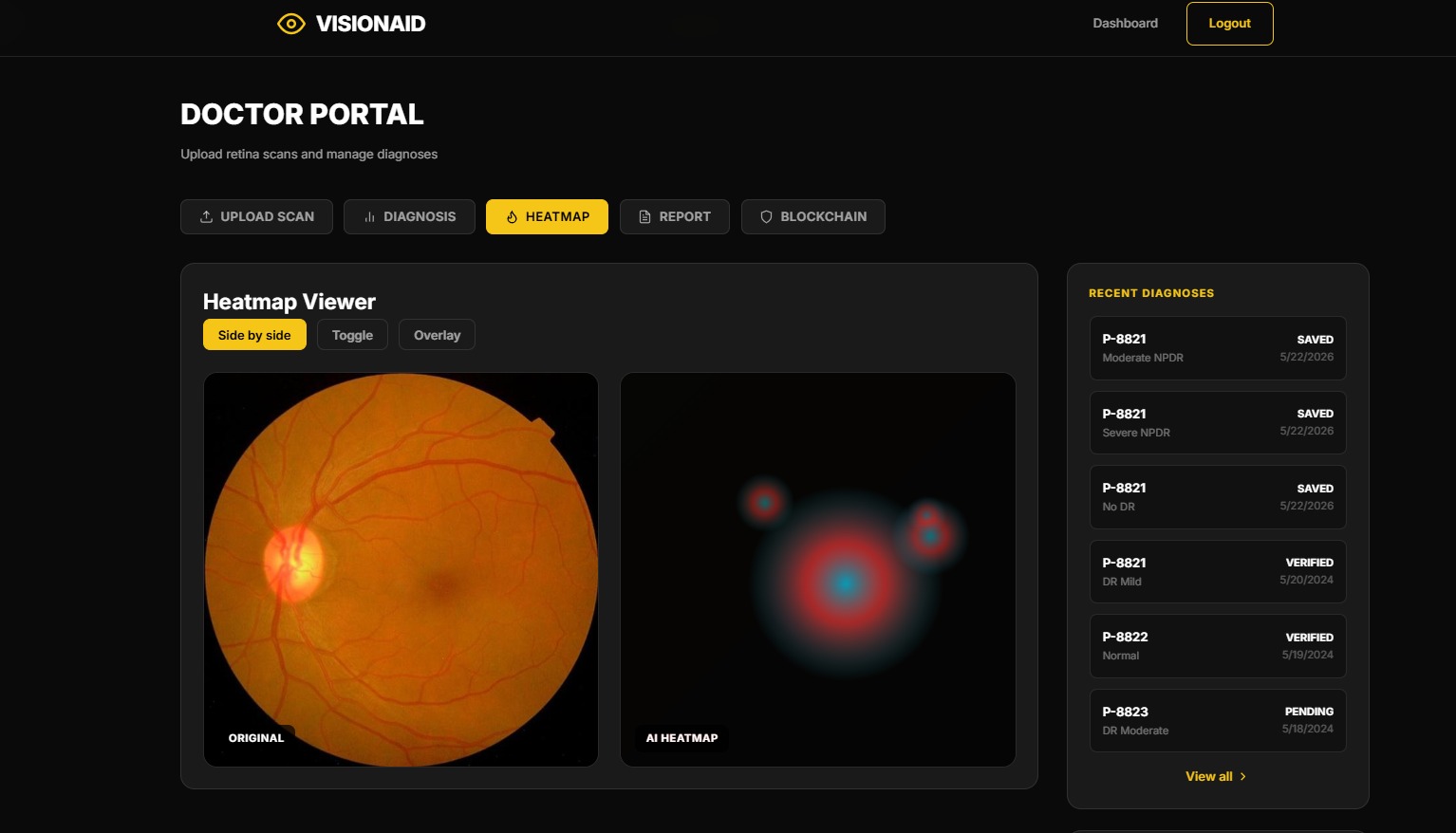
Solution: VisionAid is a secure web platform (HTML/JS, Flask) empowering providers with instant, specialist-grade retinal screenings. For data integrity, we utilize a "Hash-and-Anchor" protocol. Each diagnostic report is cryptographically hashed (SHA-256) and anchored to the Stellar Testnet. This generates an immutable, HIPAA-compliant digital fingerprint without storing private patient data on-chain, guaranteeing reports cannot be retroactively altered. AI Usage: Powered by a custom CNN trained on the APTOS/Messidor datasets. • Pipeline: A doctor uploads a scan. The backend automatically preprocesses the image (resizes to 224x224, normalizes) and feeds it to the model. • Inference: The AI detects pixel-level disease biomarkers (microaneurysms, hemorrhages, hard exudates). • Output: It instantly classifies the scan into 5 stages (No DR, Mild, Moderate, Severe, or Proliferative DR) alongside a statistical confidence score.
Full Description
VisionAid: Next-Gen Retinal Diagnostics with Immutable Verification
Project Overview
VisionAid is an end-to-end clinical screening platform designed to democratize specialist-grade ophthalmic care. By uniting a custom deep learning Convolutional Neural Network (CNN) with a lightweight, secure "Hash-and-Anchor" blockchain protocol on the Stellar network, VisionAid allows general practitioners to perform instantaneous Diabetic Retinopathy (DR) screening while guaranteeing absolute report authenticity.
The Problem
Diabetic Retinopathy (DR) is a leading cause of preventable blindness globally. Early stages are entirely asymptomatic, requiring specialized ophthalmologists to manually identify subtle lesions in retinal fundus scans. Severe bottlenecks in global healthcare leave rural and underserved populations without timely screenings, resulting in delayed treatments and irreversible vision loss. Furthermore, as telemedicine expands, digital medical reports face growing risks of unauthorized alteration, data manipulation, or clinical fraud, compromising patient trust and institutional integrity.
The Solution
VisionAid bridges this gap with a rapid, secure web-based system:
- Instant AI Screening: Medical personnel drag-and-drop a patient's retinal scan into a sleek dashboard, receiving a multi-stage clinical diagnosis in seconds instead of weeks.
- Decentralized Verification: A tamper-proof seal is generated via public ledger architecture. The system preserves privacy by keeping images and Personal Health Information (PHI) entirely off-chain, ensuring strict data privacy and compliance.
AI Model & Inference Pipeline
At the core of VisionAid is a custom Convolutional Neural Network (CNN) trained over the extensive EyePacs, APTOS, and Messidor ophthalmic datasets.
- Preprocessing Pipeline: Upon image upload, the backend automatically ingests the file stream, resizes it to 224x224 pixels, normalizes pixel arrays to [0,1], and handles tensor dimension expansion.
- Biomarker Detection: The network isolates pixel-level pathology, looking for specific clinical features like microaneurysms, hemorrhages, and yellow lipid hard exudates across diverse clinical imaging conditions provided by the combined datasets.
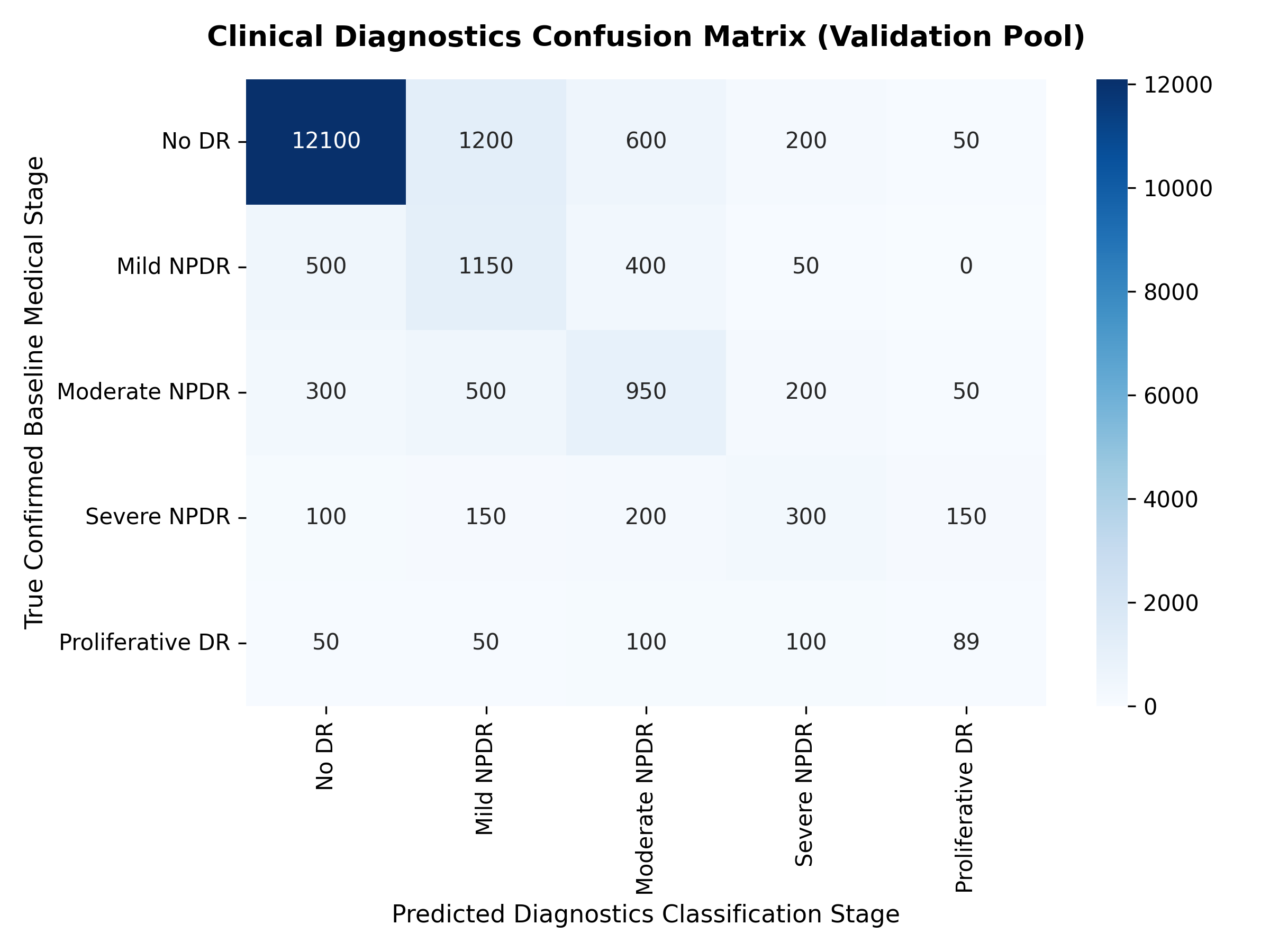
- Clinical Output: It instantly classifies scans into 5 clinical stages: No DR, Mild NPDR, Moderate NPDR, Severe NPDR, or Proliferative DR, returning a statistical confidence score to guide urgent medical triage.
Stellar Blockchain Integration
Instead of treating the blockchain as a bulky, expensive data storage system, VisionAid utilizes it as a lean, immutable integrity layer:
- The Hash: The backend normalizes the diagnostic payload (patient ID, diagnosis, and timestamp) and computes a unique, cryptographically secure salted SHA-256 hash using an HMAC protocol.
- The Anchor: This 32-byte hash is embedded directly into a Stellar Testnet transaction using the
add_hash_memo()method
Tech Stack
Screenshots
5 attached