Arch btw
MedLens — The Verifiable Radiology Co-Pilot
"Token limit exceeded."
Submitted
May 22, 2026, 5:58 AM
Last Updated
May 22, 2026, 6:17 AM
Project Links
Official Winner
This project was recognized for outstanding achievement in the Stellar Award category at Catalyst 2K26.
Problem Statement
Based on the recent developments in 'AI in healthcare' as mentioned in research survey papers, we notice a commonly cited problem in the limitations. These problems are - Hallucinations of LLMs in critical healthcare tasks, Following the privacy concerns in accordance to the HIPAA and other laws, and Lack of trust by doctor in AI Models due to their black box nature. Hallucinations is addressed through implementation of RAG and Verification agent, which checks the generated report and RAG output through similarity rating. Privacy concerns is addressed by using locally deployable small models and stellar for asymmetric encryption between doctor and patient data. Trust is addressed through XAI Layer, RAG, and verification agent which doctors can check and trust the model outputs.
Solution & AI Usage
MedLens was built as a multi-agent AI system where each module performs a dedicated task and all agents are coordinated through a FastAPI backend orchestrator. We used Streamlit for the frontend because it allowed us to quickly create an interactive interface for uploading chest X-rays and clinical notes. For disease detection, we used TorchXRayVision DenseNet-121 since it is pretrained on large chest X-ray datasets and supports multiple thoracic disease predictions. To make the model explainable, we integrated Grad-CAM heatmaps that visually highlight the affected regions in the X-ray. To reduce hallucinations, we implemented a RAG pipeline using ChromaDB and sentence-transformers to retrieve trusted medical evidence before report generation. We used Groq API with Llama models because it provides ultra-fast inference suitable for real-time healthcare workflows. Finally, we integrated Stellar Blockchain for secure and patient-controlled medical record access. in emergency settings.
Full Description
MedLens — The Verifiable Radiology Co-Pilot
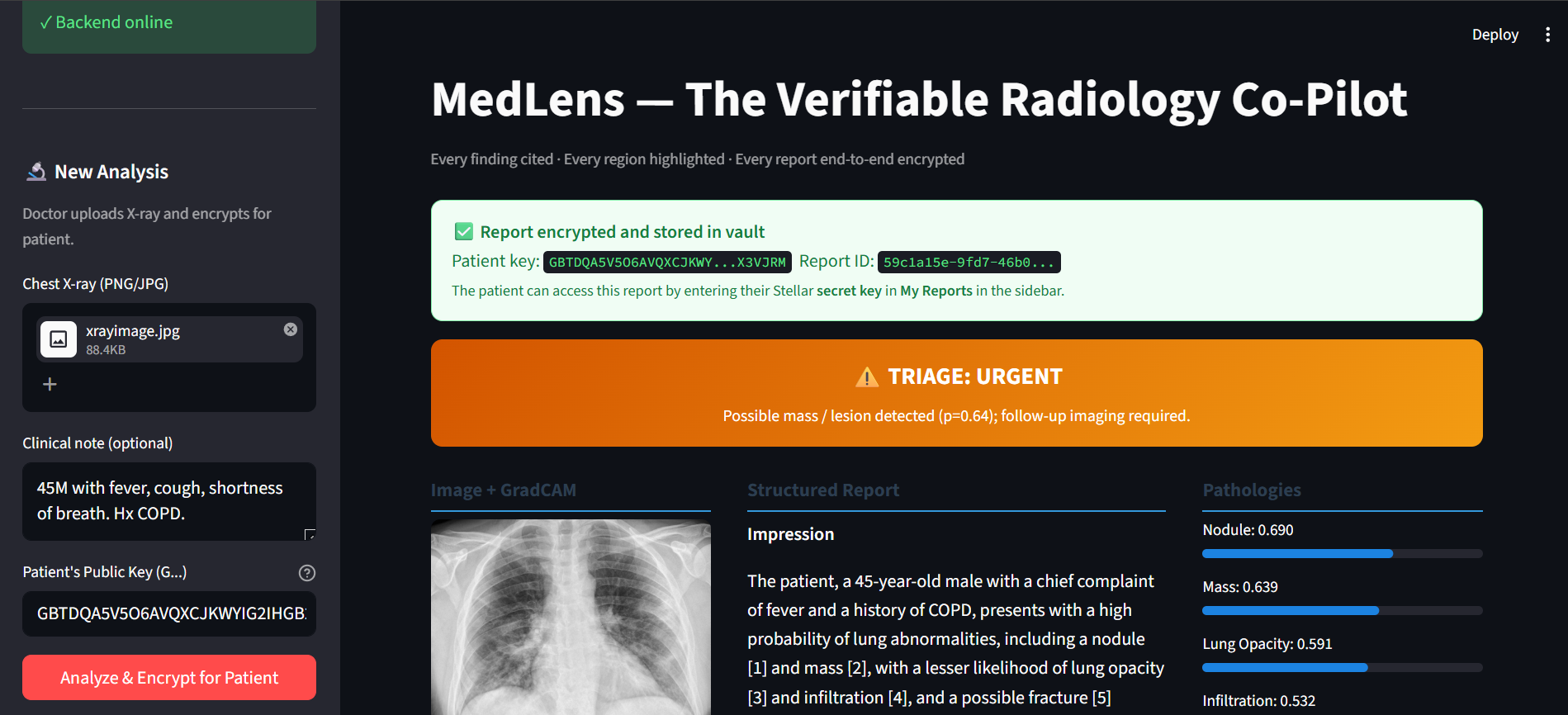
MedLens is a research-inspired multi-agent AI system for chest X-ray triage and report generation. It combines Computer Vision, Explainable AI, Retrieval-Augmented Generation (RAG), verification pipelines, and Stellar Blockchain security into one clinically grounded workflow. The system accepts a chest X-ray image and optional clinical notes, then generates pathology predictions, Grad-CAM explainability heatmaps, evidence-grounded radiology reports, urgency triage classification, and secure encrypted report sharing.
Key Features
- AI-based pathology detection using TorchXRayVision DenseNet-121
- Grad-CAM heatmaps for explainable diagnosis
- RAG-based evidence retrieval using ChromaDB
- Verification Agent for hallucination filtering
- Rule-based + LLM-assisted triage engine
- Secure patient-controlled report sharing using Stellar Blockchain
System Architecture
The architecture follows a modular multi-agent workflow. A doctor uploads a chest X-ray and clinical notes through the Streamlit frontend. The request is routed to the FastAPI orchestrator, which coordinates multiple AI agents in parallel.
The Vision Agent analyzes the X-ray and predicts thoracic diseases such as pneumonia, pneumothorax, edema, and cardiomegaly. The Explainability Agent generates Grad-CAM heatmaps that visually highlight the affected regions in the X-ray. The Context Agent processes clinical notes using BioMedBERT to extract symptoms and medical entities.
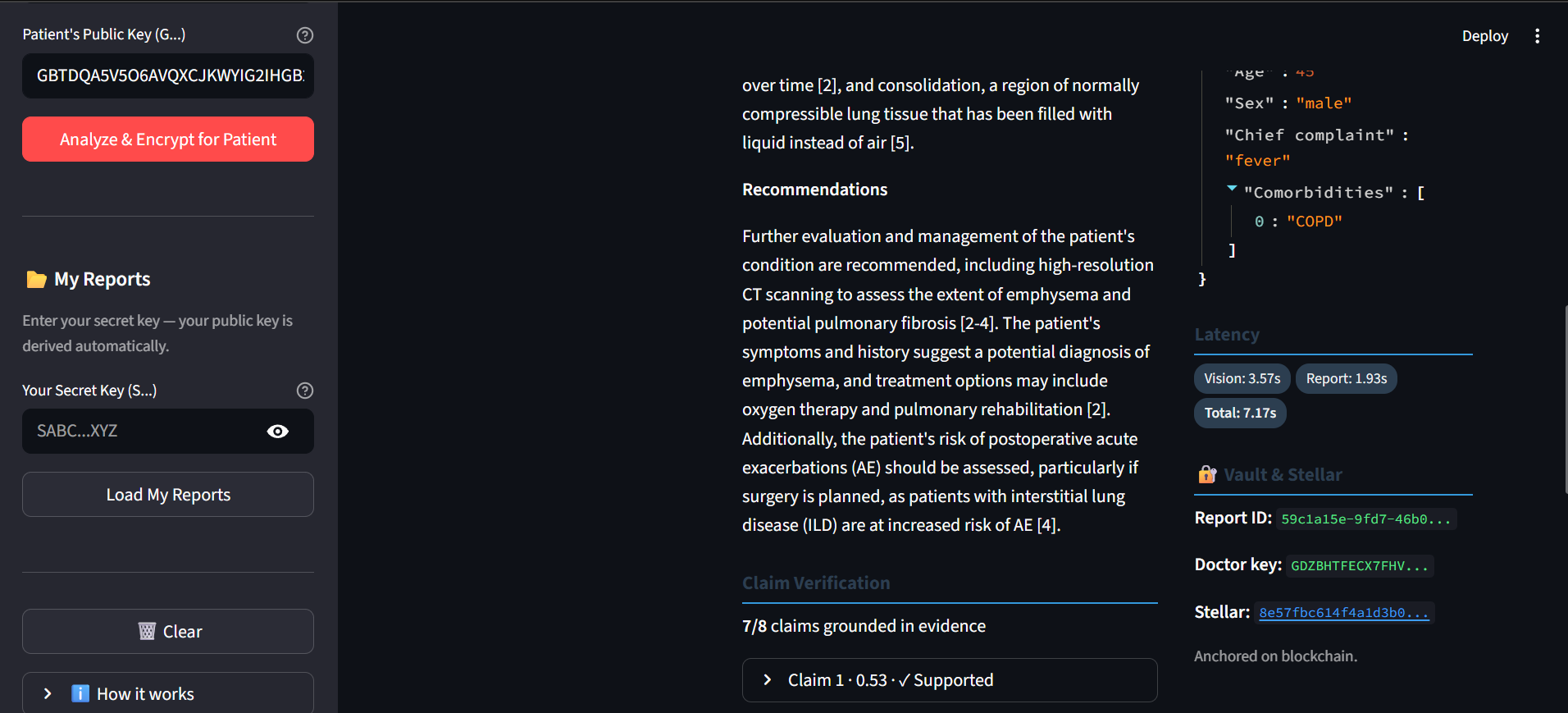
The Retrieval Agent uses ChromaDB and sentence-transformers to retrieve trusted medical evidence from sources such as Radiopaedia and NIH references. The Report Agent uses Llama models through the Groq API to generate structured radiology-style reports with inline citations. The Verification Agent then validates every generated medical claim against the retrieved evidence and removes unsupported statements.
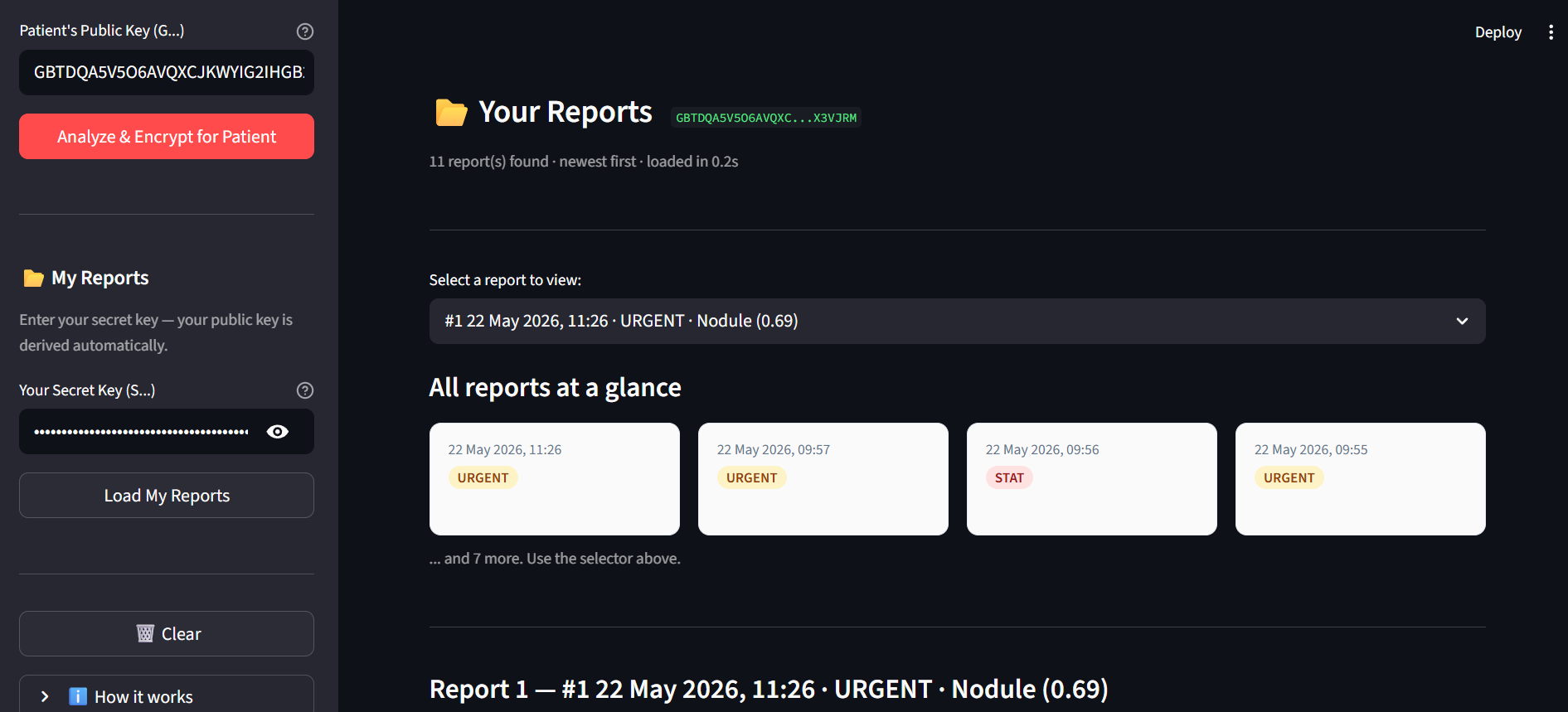
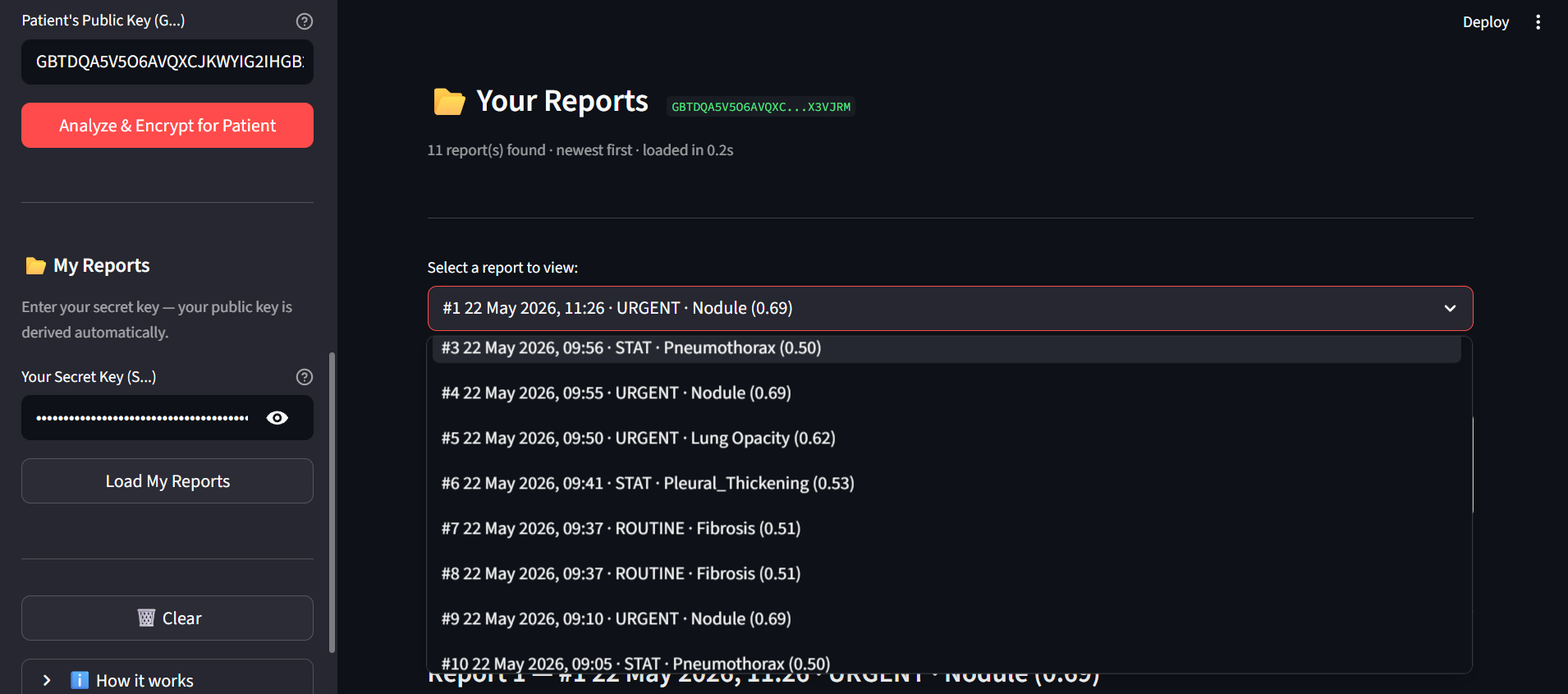
Finally, the Triage Engine classifies the case into STAT, URGENT, or ROUTINE categories. After verification, the final report is encrypted using the patient’s public key and securely stored through Stellar Blockchain integration. Only the patient can decrypt and access the report using their private key.
Learning and Challenges
Through MedLens, we learned multi-agent orchestration, RAG pipelines, explainable AI, medical report verification, and blockchain-based healthcare security. Major challenges included reducing hallucinations, generating accurate heatmaps, retrieving relevant evidence, maintaining low latency, and integrating secure encryption while preserving usability.
MedLens aims to make healthcare AI explainable, trustworthy, secure, and clinically usable, especially for emergency and rural healthcare environments. Built for trusted care!.
Tech Stack
Screenshots
4 attached